Tibet Explorers Attacked by Devil Worshipers!

Tibet Explorers Attacked by Devil Worshipers

Over the last few months I have put up a series of posts discussing the portrayal of Tibet in popular western media. For the most part, these sources talked about Tibet as a land of mystical enchantment, filled with gentle monks and high-minded sorcerers. Lest you think that western portrayals of Tibet are all oohs and aahs, however, I here present a couple of selections from a short article found in an 1898 coffee table book called Revelations of the Grandest Century. As always, I came across this while researching something totally different. Funny how that happens.

In the first picture, at right, we find a band of masked hoodlums shooting at a gallant and daring group of British explorers. Poor old chaps. Between their painted faces and fiendish masks, these bushwhacking Tibetans clearly deserve the epithet ‘devil worshipers.’

Lamaist Priests Torturing Mr. Landor
Next, we have an image of one Mr. Landor, stoically undergoing torture on the rack at the hands of a bunch of Tibetan lamas (I have no idea where they came up with the beards and turbans). Now while it would be tempting to chalk this up to a fanciful imagination, it is actually a true story. Henry Savage-Landor did, in fact, try to sneak into Tibet in the late nineteenth century. For all his trouble, however, he earned nothing but torture and deportation. His 1898 account of this trip, Into the Forbidden Land, captivated Europe, and will be the subject of a future blog post. (Download it free from Google Books!) For now, I will just leave you with these two wonderful images, traces of the dark side of the western fascination with Tibet.

Ewoks Speak Tibetan!

For years, people have told me that the Ewoks, the furry creatures from George Lucas’ film, Return of the Jedi, spoke Tibetan. I have even passed along this piece of gossip to others, quietly chuckling about Tibetan’s little moment in the spotlight. So you can imagine my joy when I came across the following article confirming the story. The article is from the September 1983 issue of Tibetan Review magazine, which I stumbled across while doing wholly unrelated research (Really, I was. I promise). There is no byline, so we can just attribute it to the editors of Tibetan Review. It is a short article, so I will present it here in full. And remember, this is from 1983, the same year the movie was released.

Ewoks, the furry teddy bear like creatures featured in the blockbuster film Return of the Jedi, speak a curious language in which many Tibetan words and sentences are clearly distinguishable. This is a fact which even Producer George Lucas may not be aware of. When the film was released in the United States, reporters asked people working for Lucas whether the Ewok language is nonsense. They were told. “No, it is not. It is Tibetan run backwards!”

Much of what the Ewoks spoke could very well be nonsense or even Tibetan spoken backwards. However, the rest are definitely Tibetan spoken by real Tibetans. Among words the Ewoks are heard employing are Tibetan for “Hurry! Let’s move,” “No, it’s not him. It’s the one over there,” “There is lots of money here! There is lots of money here!” (in a scene where no money of any kind is in sight!), and a brief prayer.

Tibetan film buffs in Delhi and Dharamsala, who have seen the film on video, suggest the following solution to the mystery: Steven Spielberg, friend of Lucas, shot a small sequence of his film Raiders of the Lost Ark in Nepal. When there on location, he may have recorded various stray voices in the bazaars of Kathmandu (which would explain the above references to money) for possible use in future. So when friend Lucas was looking for exotic sounds to attribute to his furry creatures, Spielberg made his tapes available. Q.E.D. Next problem, please.

Great to hear that Tibetans can actually understand what the Ewoks are saying, but somehow I don’t think Lucas used Steven Spielberg’s Kathmandu street recordings. Fortunately, we have Wikipedia. The ‘Languages in Star Wars‘ entry provides several possible solutions to where the Tibetan comes from, and even indicates that the incomprehensible bits may not be Tibetan at all, but Kalmyk. Those interested in a more academic approach should check out Maria S. Calkowski’s article, “Is there Authoritative Voice in Ewok Talk: Postmodernism, Fieldwork and the Recovery of Unintended Meanings,” which can be found in the journal Culture, vol XI, 1991, pages 53-64, freely available on Google Books.

Yushu Earthquake Relief Efforts

[last updated April 22, 2010]

As many of you probably know by now, an earthquake struck northeastern Tibet during the early morning hours of April 14th. The earthquake had its epicenter about 30km from Jyekundo, the capital of Yushu County in Qinghai Province, China. (Click here for an interactive map, courtesy of THL) While the area is sparsely populated, the reports I’ve seen have indicated that casualties and damage are both pretty extensive. The area is populated primarily by Tibetans, andmany individual family homes have collapsed (originally it was reported that these were mostly built with traditional adobe construction, though I have now heard that most were, in fact, built of cinder blocks with pre-fab concrete roofs). As with the 2008 Sichuan earthquake, many schools collapsed. Currently, over 2,000 people are listed as dead, with over 12,000 injured. The following is an excerpt from a blog post by Losang, of Plateau Perspectives. The full report is well worth reading and has several striking photos.

My family and I were in our 3rd floor apartment building when the earthquake hit. There was a smaller earthquake (around 4.7) that occurred around 4am and neither my wife or I could get back to sleep. When the big quake hit, my wife was using her computer while our younger son Norbu (18 months old) was playing in the living room. Tsering, our older son who is 3 years old, was still asleep in the back bedroom. … Norbu flew across the room when the quake hit. My wife was also violently thrown to the ground. Everything in our apartment began to be tossed around, breaking when it hit the walls or floor. I ran to the back bedroom and grabbed Tsering and grabbed him as my wife grabbed Norbu off the floor. Together, we ran to the door. I paused long enough to grab my shoes, coat and a bit of money. I opened the door and one of our Tibetan neighbors assisted us in carrying Tsering down the 3 flights of stairs to the ground floor. All of us were in just our pajamas. I was the only one of my family who managed to get shoes.

The Associated Press is reporting that large convoys of relief material is finally making it to Jyekundo, just in time for Hu Jintao’s arrival. The New York Times has also been emphasizing the role that monks have played in relief efforts, though I have heard that their report on tensions between monks and police may suggest more tension than there actually is.

The following groups still need assistance. As the relief effort shifts to rebuilding, it is more important than ever that local NGOs and others who know the people and landscape have the resources they need to be effective.

Local NGOs

Snowland Services Group is a Tibetan NGO currently on the ground in Jyekundo. While their own operations were hard hit during the earthquake, and at least one staff member was killed, they are seeking to provide water, food, tents, clothing and bedding. Recently, they have organized a relief consortium in Xining called Yushu Earthquake Response (YER). Other members of this group include Shem Women’s Group [click here for my earlier post on this group], Pentok Institute, Sanchuan Fazhan Cujinhui, Tsong Ka Charity Association and Xiangcun Zhiyou. The organization does not have its own website, yet, but funds donated to the Tibet Village Project will be routed to them, through existing contacts.

Plateau Perspectives is a western NGO also based in Jyekundo, and may be the only western NGO authorized to distribute aid so far. They have many years of experience and contacts in the region and already have gotten at least one team of doctors into Jyekundo, with the government’s blessing. They also have the most fully developed web-presence of these small groups, yushuearthquakerelief.com, a site which now includes video taken just a few minutes after the earthquake hit. Donations cane be made through this site.

Rokpa is an international NGO that runs a school in Jyekundo. I have heard that all of the children survived, though one teacher was killed and the school buildings are in rubble. They are also accepting donations for earthquake relief, though they do not yet have a dedicated website set up. Donations can be made through their general website rokpa.com, and should be noted as being for earthquake relief.

Sichuan Quake Relief is an organization founded to provide relief efforts after the 2008 Sichuan Quake, who have now turned their attention to the Yushu Earthquake. They have managed to get beyond the town of Jyekundo to reach some remote villages, and have found them devastated, with no relief in sight. Donations can be made through their clear and well organized website, sichuan-quake-relief.org.

Gerald and Elena are a pair of foreign workers teaching Tibetans in Xining, the provincial capital. As of April 15th, they had organized at least one truckload of supplies, including blankets, water, food and tents. The total bill for the supplies came to just over $700; proof that small donations really can help. They can be reached through Gerald’s e-mail address: gjroche@gmail.com.

Global NGOs

In my original post, I said that foreign NGOs operate under strict regulations in China, so it was not feasible to donate to large groups like the Red Cross. I have since noticed that both the Red Cross and Mercy Corps are soliciting donations for Yushu Earthquake relief, so presumably they are planning to put relief operations in place as soon as they can. I’m still not sure what kind of red tape they will have to deal with, however. If you are interested in donating to either of these groups, click here: Red Cross, Mercy Corps.

If you have any questions, please feel free to e-mail me, and I will do my best to answer, or at least to pass the question along to someone who might be able to answer it.

Thanks to Robbie Barnett, Gray Tuttle, Clay Goforth, Brenton Sullivan, Losang and Tamdin Wangdu for bringing these groups to my attention.

The Comics Connection II: Dr Strange Goes to Tibet (and Greenwich Village too)

When I wrote about Batman’s tögal practice (click here for that post), several people wrote to tell me about Dr Strange, a Marvel Comics character from the sixties who also studied esoteric practices in Tibet. So I ordered it up through inter-library loan and waited. For a while. Finally, a copy of The Essential Doctor Strange arrived, having come all the way from Fairbanks, Alaska. This is, I think, the farthest distance from which I’ve ever received an inter-library loan book. Now that the book has arrived, however, I must confess to being a little disappointed. The plots are, well, a little strange, even by comic book standards. But no matter, Dr Strange has studied in Tibet, and that makes him interesting to me.

Dr Strange is a master of black magic, but he uses the dark arts to protect mankind, warding off villains such as Baron Mordo and Nightmare (a character who bears a striking resemblance to Neil Gaiman’s Sandman). He learned these skills studying at the feet of The Ancient One, at a hermitage deep in the mountains of Tibet. If it weren’t for the repeated references to Tibet, however, it would be impossible to tell where these classes take place. Neither the setting nor the practices these figures engage in bear any resemblance to anything you might actually find in Tibet. Even the mystic writing in Dr Strange’s books is just some odd circles. At least when The Green Lama chants his mantras, the artists take the trouble to get the script right (I’ll be posting about the Green Lama just as soon as inter-library loan gets the book to me). For Stan Lee, Doctor Strange’s main author, Tibet seems to be nothing more than an exotic location in which an American hero can learn about black magic. Not much new here.

But Tibet is not the only place mentioned repeatedly in the Dr Strange comics. The other is Greenwich Village, New York City. This is where Dr Strange himself resides (at least, when he’s not traveling through other dimensions in a ethereal body). Dr Strange’s house also bears a certain resemblance to The Ancient One’s Tibetan hermitage, particularly in its odd spider web windows. The implication seems to be that Greenwich Village is the new Tibet, home of oddball mystics and the occult. Dr Strange was first published in 1963, and at that time Greenwich Village must have seemed remote and exotic to many Americans. It had beatniks, Bob Dylan and LSD. What better place to imagine as the American abode for the mysteries of Tibet?

Shem Women’s Group

In honor of International Women’s Day, I thought I would try to call some attention to the Shem Women’s Group [ch: 祥母慈善协会]. This organization, run by a group of four Tibetan women, encourages women to design, organize and execute development projects in their individual communities. Shem thus makes a direct impact on the lives of villagers by providing needed services such as water-works, solar electricity and plumbing.

Perhaps more importantly, however, Shem challenges Tibetan gender stereotypes. While Tibetan gender roles may not be as rigid as those in other parts of Asia, there are still deeply held ideas regarding the spheres of activity appropriate for men and women. Speaking generally, women are responsible for most household labor and chores, while men are responsible for taking care of the business side of things. In practice, this means that women do most of the heavy lifting, while men take credit for a family’s prosperity. Being female is widely regarded as an inferior birth, the result of negative karma, and women are generally seen as less capable than men.

By encouraging and enabling women to design and perform projects in their home villages, the Shem Women’s Group is forcing other villagers (particularly male villagers) to recognize that women are capable of undertaking and completing major projects outside the home. Last week, Lhamotso, one of the group’s directors, gave a talk about the group at UVA, and her experiences speak to the effectiveness of this approach. When she first started working with Shem she was ridiculed and her family was pressured to make her stop. After completing a few projects, however, she found herself the recipient of social acclaim and approval. Now, she reported, the village headman now comes to her house to speak with her. Another person told her father that she was, “better than a son.” Clearly the Shem Women’s Group’s approach to challenging Tibetan gender norms is having an effect.

For more information on this group, or to donate to their effort, please click here.

I’m sure the Shem Women’s Group is not the only group out there working on gender equality issues in Tibet, but having just attended Lhamotso’s lecture, it is fresh in my mind. If anyone reading this knows of other groups working on this, please let me know via the comment box below.

The Comics Connection I: Batman does Tögal!

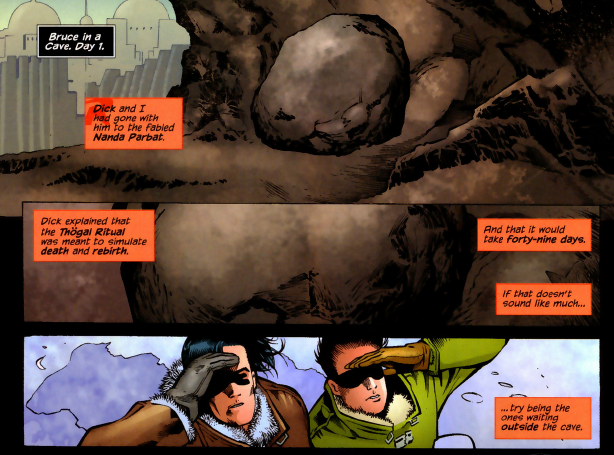
As we know, Batman is a man of many talents. Among his lesser know skills is a mastery of esoteric Tibetan meditation practices. Yes, Batman does tögal. His mastery of this technique is revealed in the R.I.P. series of comics, where he uses tögal to experience death, overcoming his last shred of fear. Pretty neat. For those of you who are unfamiliar with tögal (tib: ཐོད་རྒལ།), it is a Dzokchen practice where a practitioner allows their pure nature to shine forth in the form of luminous Buddha images. Rather than being intentionally visualized, these forms appear spontaneously to a practitioner’s visual consciousness. Last time I checked (and I’m hardly an expert on this), tögal is not usually presented as a rehearsal for dying.

But I’m getting ahead of myself. Before we dismiss the Dark Knight as an impostor, we should take a look at how he describes the practice he’s doing. In Robin 175, we learn that the tögal ritual Batman performs (and it is consistently called a ritual, rather than a practice, but let’s not get hung up on semantics) involves staying shut in a Nepali cave for forty-nine days. The goal, we are told, is to simulate death and rebirth. This does not give us much to go on, even though tögal can be performed in a sealed and darkened room, and forty-nine days is the traditional length for the period between death and re-birth.

For more detail, we need to turn to the opening pages of Batman 681. Here we find Bruce Wayne relaying his tögal experiences to a monk. “As I lay in the darkness,” he says, “I began to experience vivid hallucinations of the past and present, even the future. But then I came to the end of even that. I found myself in a place that’s not a place.” “In tögal,” the monk replies, “the initiate learns what the dead know. The self is peeled back to its black, radiant core.”

Now we’ve got something to compare with traditional understandings of tögal. First off, we have visions. Check. So far so good. Then the visions stop. In traditional tögal, the final stage of the practice is when all of the visions collapse back in on themselves. Again, check. Finally, we learn that the point of the practice is to reveal the radiant core of the self. In traditional presentations, it is a person’s pure, radiant nature that is the source of tögal’s visionary experiences. So actually, we’re not too far off here. I don’t think many tögal practitioners would describe this radiant core as black, but then again this monk has just tried to murder Batman, so perhaps he was only referring to himself. Again then, check. If Bruce only stopped here, we could say that he actually does a halfway decent job of sticking to themes found in real-world tögal.

Instead, however, Bruce brings things back to death. A few pages later, he reveals to the monk why he undertook the tögal ritual, “I wanted to taste the flavor of death. I wanted to know that I had experienced every eventuality.” Again, we’re back to the idea that tögal somehow simulates the death and re-birth process. Now, to be fair, texts such as the Bardo Tödröl (popularly known as The Tibetan Book of the Dead, a text which hails from the same practice tradition that gives us tögal) claim that after death, one experiences spontaneous visions of Buddhist deities. Further, these visions are projections of an individual’s radiant core, just as in tögal. So it might not be too far fetched to see tögal as something of a rehearsal for the events that occur during the death process.

Traditionally, however, tögal is not usually presented in this way. Instead, it is a practice for revealing the pure, radiant nature of everything someone experiences, with death being just one experience among many. This may not seem like much of a shift, but it goes to the heart of the practice. Tögal is a practice concerned with experiencing primordial purity in the present moment, rather than a means to prepare for a future event. For an accomplished practitioner of tögal, the death process should be just as radiant and pure as every other moment of their life. So, no, Batman doesn’t quite have his heart in the right place when he undertakes this practice.

Still, we have to give DC Comics’ writers some credit here. Despite not quite getting the overall intent of the practice, they came pretty close on lots of the details. Others they missed, such as the ‘Tibetan’ monastery that looks strikingly Japanese, or the cave that looks more like depictions of Jesus’ sepulcher than any Tibetan retreat cave I’ve ever seen. Clearly, however, someone on their staff was into researching obscure Tibetan practices, and we should applaud them for not just making things up, even if the final product is a little off.

Thanks to David Germano for bringing Batman’s tögal mastery to my attention.

New Address, New Look

My little corner of the web now has a new, more permanent home: thelostyak.com. This blog has been up for almost two months now, and it seemed high time to clean things up a little. It also turns out that Random Ruminations, my old blog title, was already being used by several other people. A google search for The Lost Yak, on the other hand, comes up empty, allowing me to claim squatter’s rights. While the old address (geoffbarstow.wordpress.com) will redirect to the new site, you may want to change any bookmarks you have. If you have already subscribed to e-mail updates, I don’t think you have to do anything.

Along with the new address, I decided it was time for a little spring cleaning, and have re-done the blog’s appearance. Same basic color scheme and layout as before, but a little more refined. For those who are interested, I took the picture in the fall of 2005, near Thamé Gompa in the Khumbu region of Nepal.

And lest you think that I’ve only been worrying about these trivial details, there is more content in the pipeline as well. I’m currently putting the finishing touches on a post about Tibetan visionary practices and Batman. Yes, Batman does Thögal. You can expect the full post sometime next week.

Japanese Swords in Tibet

When I was in Kham three years ago, I saw a Japanese knife for sale in a store in Ganzi (tib: དཀར་མཛེས།; ch: 甘孜). It was a tanto, the knife-sized little brother of Japan’s famous katana, or samurai sword. This particular knife had a nice hamon, the pattern that emerges along the edge of a hand-made blade. When I expressed interest in it, the shop keeper happily removed the ray-skin handle to show me the maker’s signature on the hilt. While I don’t know much about these things, this was clearly a real, hand-made Japanese knife blade, not something mass-produced for the tourist trade. Such knives are not common. Which leads to the obvious question, what on earth was it doing in a little shop in remote eastern Tibet?

A few days ago, I may have found the answer. I was reading A Tibetan Revolutionary, by Melvyn Goldstein, Dawei Sherap and William Siebenschuh. This book presents the memories of the Tibetan Phüntso Wangye (Phünwang), a devout communist who dedicated his life to establishing effective communism in Tibet. It’s a good book, and offers some valuable insight into the strategies and internal debates surrounding the Chinese Communist Party’s involvement in Tibet in the 1950s.

One of the tasks Phünwang undertook for the CCP was to travel to Central Tibet with some People’s Liberation Army Generals in an attempt to convince the Tibetan aristocracy to accept Chinese rule without a fight. Part of this effort involved distributing bribes. As he describes it, “Since Deng Xiaoping had stressed the importance of building good relationships with the Tibetan upper classes, I brought gifts – Japanese swords, radios, brocade silk, and so on – to be distributed when appropriate.”[1]

While it seems unlikely that the particular tanto I saw in Ganzi was one of those brought to Tibet by Phünwang, the fact that such weapons could be effective presents for currying favor with the Tibetan elite does indicate that wealthy Tibetans knew about and valued Japanese swords. There must, therefore, have been some trade in these blades going on between China (where they had presumably been captured from Japanese soldiers during WWII) and Tibet. It seems reasonably likely that the knife I saw in Ganzi was part of this trade, and may have arrived in Kham during the period between the end of WWII and the upheavals of the 1950s. Or maybe not, but it’s a fun theory.

_____________________________________

[1] Goldstein, Melvyn C., Dawei Sherap, and William R. Siebenschuh. A Tibetan Revolutionary: The Political Life and Times of Bapa Phüntso Wangye. Berkeley: University of California Press, 2004. p. 137.

Pulp Fiction in Tibet

As many of you know, I have a little thing for collecting old books, particularly those about Tibet. Mostly, this means books that are written by explorers or missionaries, and which can be rather stuffy and self-important. Recently, however, I’ve stumbled across a new type of Tibet-related book: pulp fiction. That’s right, cheap, crappy mystery novels set in the magical and mysterious land of Tibet!

So far, I’ve only come across three of these, but they’re all pretty juicy. The first was William Dixon Bell’s The Secret of Tibet, a piece of juvenile fiction that follows the adventures of two American aviators lost in ‘the sacred lamaseries of forbidden Tibet’. The duo discover a lost race, solve some mysteries, and generally have a good time. If this plot sounds familiar, it might be because James Hilton’s Lost Horizon, the piece of fiction that introduced the world to Shangri-la, also follows the adventures of some stranded aviators who discover a lost race. The Secret of Tibet was published five year’s after Lost Horizon, and a year after Frank Capra’s film adaptation. Nobody said that pulp fiction had to be original.

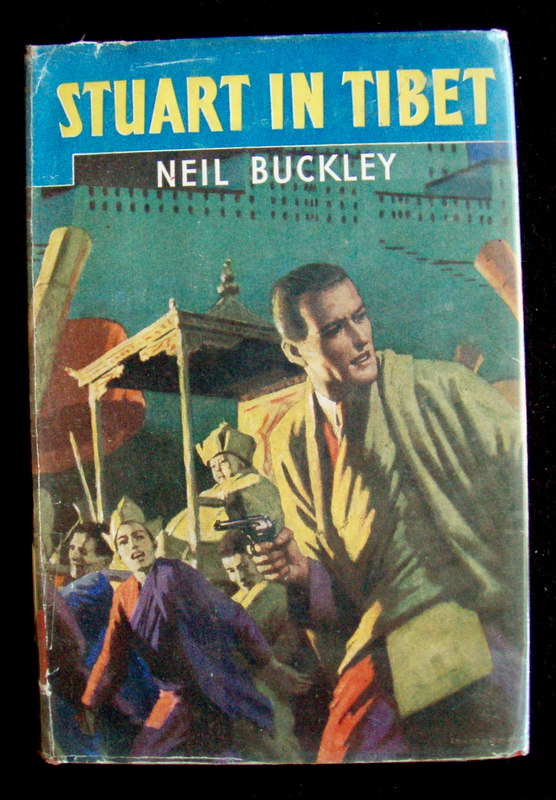
Next in the lineup is Clyde Clason’s The Man from Tibet. This 1939 mystery takes place in Chicago, but the plot is features a mysterious Tibetan manuscript, and an even more mysterious academic who deciphers it. Who knew academics could be so exciting? Lastly, we have Stuart in Tibet, a 1949 adventure by Neil Buckley. This novel chronicles the stories of a British agent who becomes involved in a dispute between the Tibetan and Chinese governments over rival candidates to succeed the recently deceased Dalai Lama.  Despite being a work of popular fiction, it displays a striking awareness of Tibetan political controversies, while simultaneously propagating Imperialists notions by having a western intelligence agent sort things out.[1]  The cover is great. We’ve got a dashing American in monk’s robes brandishing a gun, protecting the Dalai Lama, who is seen cowering in the background. What’s not to love?

So that’s it, a little bit about a couple of books I came across recently. If anyone reading this knows about any other books along these lines, feel free to let me know! And keep your eyes peeled for some updates to this post, as more of these gems come to light.

References:

[1]Bishop, Peter. 2001. “Not Only a Shangri-la: Images of Tibet in Western Literature.” In Imagining Tibet, ed. Thierry Dodin and Heinz Räther, 201-221. Boston: Wisdom Publications.

This article has a good discussion of the vision of Tibet found in western fiction, even referring to Stuart in Tibet.

I’ll post more references here, as I come across them. Feel free to let me know about anything I’ve missed!

Roosevelt & Muir

I heard a story recently that I thought was worth passing on. I have no idea if it is true, but I like it anyway.

John Muir

In 1903, President Teddy Roosevelt went on a train trip across the country, visiting notable scenic spots. In California, he visited Yosemite, where he met John Muir. Apparently they took a liking to each other. A dinner was planned in their honor at the Wawona lodge. Before the dinner, the two told Roosevelt’s staff that they were going for a walk in Mariposa grove. They didn’t tell the staff that they weren’t coming back that evening.

And so the founder of the conservation movement and the founder of the National Park system managed to give the secret service and everyone else the slip, and spend three days together in the woods. No tents or other gear, just conversation and the biggest trees on earth.

True or not, its a pretty good story.